

Careerfishing Is Rising. California HR’s Answer Shouldn’t Be More Opaque Screening
Careerfishing Is Rising. California HR’s Answer Shouldn’t Be More Opaque Screening
Careerfishing Is Rising. California HR’s Answer Shouldn’t Be More Opaque Screening
Careerfishing is the systematic exaggeration, distortion, or fabrication of professional qualifications across resumes, interviews, and references. It is fueled by market pressure and weak verification expectations. For California HR leaders, the right response is not to screen harder behind closed doors. The right response is to make verification clearer, more job-related, and reviewed by real people.
Candidate Embellishment Is a Market Problem, Not a Character Problem
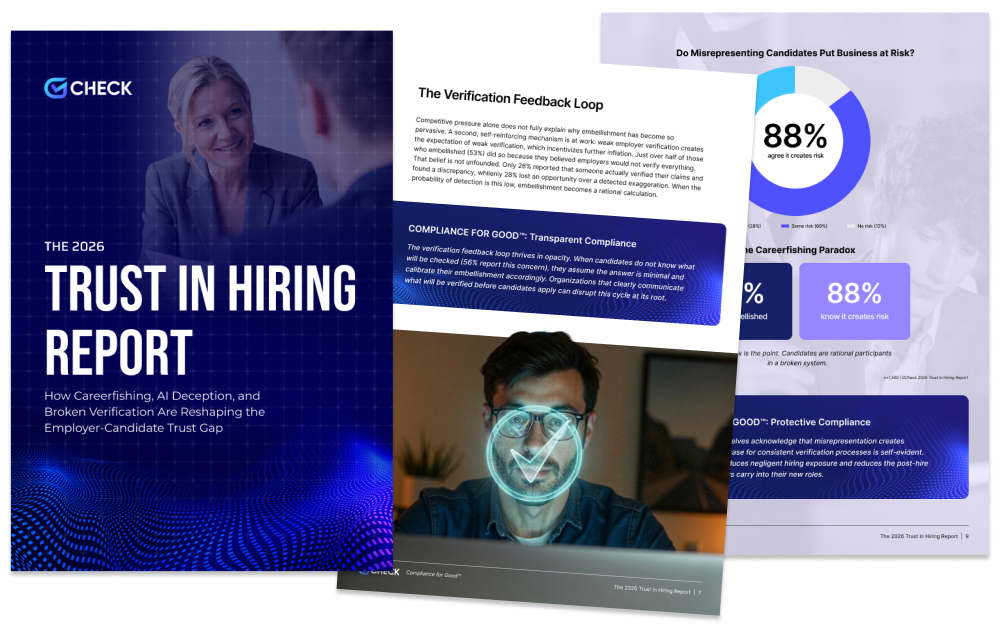
The 2026 Trust in Hiring Report from GCheck surveyed 1,500 recent U.S. job seekers and found that competitive pressure is the single biggest driver of candidate misrepresentation. Seventy-two percent said the competitive market pushed them to exaggerate. Meanwhile, 60% said they would not have been hired if they had presented themselves with full accuracy.
That second number exposes something deeper than individual dishonesty. GCheck calls it the honesty tax: the systemic disadvantage truthful candidates absorb when exaggeration becomes the market norm. In a hiring environment where inflation is standard, accuracy becomes a liability.
California employers already navigate some of the most complex hiring regulations in the country, from pay transparency requirements under SB 1162 to restrictions on salary history inquiries under AB 168. The honesty tax compounds that complexity. If the hiring process itself pressures candidates to distort their qualifications, no amount of downstream compliance can fully repair the damage.
 Why California HR Cannot Rely on Blunt-Force Screening

California’s regulatory environment already limits how aggressively employers can screen. The Fair Chance Act generally bars employers with five or more employees from asking about conviction history before extending a conditional job offer. On top of that, California’s regulations on automated decision-makingin employment, which took effect in late 2025, clarify that existing anti-discrimination laws apply to AI-driven hiring tools.
These rules make a “just screen more aggressively” posture both legally risky and strategically misguided. Layering on hidden checks or black-box filtering does not square with California employment law. Nor does it address why careerfishing happens in the first place: candidates inflate because the process feels opaque and punishing, not because consequences are missing.
The harder HR teams lean into secrecy, the more they reinforce the very conditions that make embellishment feel rational.
Candidates Are Not Only Inflating Qualifications. They Are Concealing Parts of Themselves.
Skill exaggeration and resume fabrication are the most recognized forms of careerfishing. Yet the Trust in Hiring Report uncovered a parallel behavior with far deeper implications for workplace fairness: 50% of working mothers with children under 18 avoided mentioning caregiving responsibilities during the hiring process.
This is not exaggeration for competitive gain. This is concealment born from self-protection. Working mothers are making a calculated decision that disclosing parenthood will cost them an opportunity. The EEOC’s enforcement guidance on caregiver discrimination has long warned that employment decisions shaped by caregiving assumptions can constitute unlawful discrimination under Title VII. The agency specifically flags stereotyping based on parental status as a compliance risk.
In California, where fair employment practices carry real enforcement weight, this finding raises an uncomfortable question. If candidates feel compelled to hide major parts of their lives just to stay in the running, the hiring process is generating the very distortion it claims to guard against.
Transparent Background Checks Deter More Than Secrecy Ever Will
The report’s clearest solution comes directly from candidates. Eighty-two percent said they want a clear explanation of what will be checked during the hiring process. That is not just a preference survey result. It is a roadmap.
When candidates have no visibility into what employers will verify, they fill the gap with assumptions. Some assume nothing will be checked and exaggerate freely. Others assume the worst and conceal things they should never have to hide. Both reactions stem from the same information vacuum.
Communicating verification standards upfront, ideally in the job posting itself, disrupts the careerfishing cycle at its source. Candidates who know what will be validated have less incentive to inflate. Candidates who can see that the process is job-related and limited in scope have less reason to conceal.
This approach also aligns with Fair Credit Reporting Act disclosure requirements, which already mandate specific candidate notifications during background screening. Moving that transparency earlier, to the pre-application stage, extends the same principle upstream where it can change behavior before it starts.
Three Principles for Reducing the Honesty Tax in California Hiring
Rather than a sprawling compliance checklist, HR teams operating in California can anchor screening practices around three principles:
- State what will be verified. Proactive disclosure in job postings is the most cost-effective way to discourage embellishment before a candidate ever applies.
- Keep screening job-related and reviewable by a person. Eighty-one percent of candidates in the Trust in Hiring Report said they want human review of screening findings rather than fully automated decisions. In California’s regulatory landscape, human oversight also reduces legal exposure tied to algorithmic bias.
- Design hiring processes that reward accuracy, not performance theater. When the only path forward is to outperform other candidates’ self-presentation, the system selects for the most convincing applicants rather than the most capable ones.
These principles do not ask employers to stop verifying credentials. They ask employers to verify openly, fairly, and in proportion to actual job requirements. That is the difference between a process built to catch people and one built to earn their honesty.
About GCheck
GCheck is a modern, hire-to-retire screening platform dedicated to Compliance for Good™, helping organizations hire and retain with speed, accuracy, and fairness. We operate across the entire employee lifecycle, delivering background checks, identity verification, drug testing, continuous monitoring, and compliance management through one unified platform. Our Compliance for Good™ framework is built on three pillars: transparent compliance, fair compliance, and protective compliance, ensuring every screening decision upholds dignity, reduces risk, and strengthens trust. GCheck serves enterprise HR teams, healthcare organizations, nonprofits, and regulated industries that need more than a fast check; they need a compliant, ethical, and audit-ready screening partner. Learn more at gcheck.com.